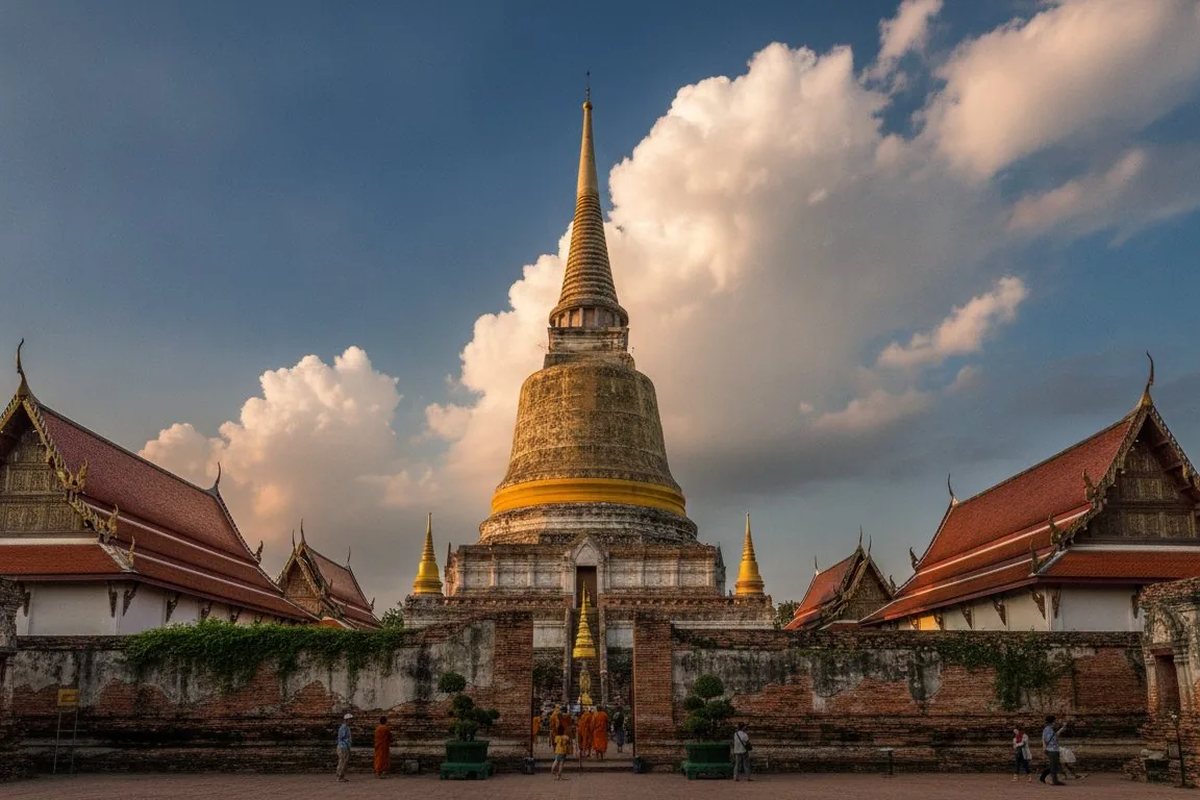
If you have been watching the Thai festivals 2026 calendar for something that is not on every tour itinerary, this is the entry to circle. Nakhon Si Thammarat holds its Sart Duean Sip fair from 28 September to 12 October 2026 — fifteen days and nights of merit-making, processions and southern performance traditions. What makes this year different is the address. The festival's ceremonial heart is Wat Phra Mahathat Woramahawihan, inscribed on the UNESCO World Heritage List in July 2026 as Thailand's ninth World Heritage property.
For a fortnight, in other words, the country's newest World Heritage site stops being a monument you visit and becomes a working temple at full ceremonial load. That is a rare thing to walk into, and it sits within easy reach of the Gulf coast beaches most visitors are already heading for.
The dates, and the four places it happens
The Tourism Authority of Thailand's September calendar puts the fair at 28 September to 12 October 2026. It is not one venue with a few satellites — it is four distinct sites across Mueang Nakhon Si Thammarat district, each with its own atmosphere:
- Somdet Phra Srinagarindra 84 Park (Thung Tha Lat) — the fairground proper: food stalls, OTOP handicraft trading, Red Cross activities and evening entertainment.
- Wat Phra Mahathat Woramahawihan — the religious centre, and the reason this fair is different from any other provincial fair in Thailand.
- Lan Sai and Sanam Na Mueang — the public grounds that carry the processions and staged performances.
- Nakhon Si Thammarat Provincial Hall — the civic and official programme.
Plan them as separate mornings and evenings rather than one loop. The temple is best early, before the heat and the crowds; the fairground only really comes alive after dark.
What actually happens at Sart Duean Sip
Sart Duean Sip is the tenth-lunar-month merit-making festival, and it is the most significant date in the southern calendar. The logic behind it is ancestral: families make offerings on behalf of their dead, who are believed to return for these few days. The visible centrepiece is the procession of hmrab — elaborate, tiered trays of offerings, built at home and carried through town to the temple.
Around that sit the performance traditions the region is known for and which you will struggle to see done properly anywhere else: Nang Talung shadow puppetry, played against a lit screen with a single narrator voicing every character, and Manora (Nora) dance, with its beaded costumes and long curved fingernails. Both are living Thai culture rather than staged tourist showpieces, which is exactly why they reward an hour of patience.
Be clear with yourself about what this is. It is not Loy Krathong. There is no set-piece spectacle designed for cameras, and almost no international audience in the crowd. If you travel for religious architecture, textiles, food or performance, this is one of the strongest fortnights of the year. If you want an easy, photogenic evening, look elsewhere on the Thai festivals 2026 calendar.

Getting there, and what it costs
Unlike most of the Thai festivals 2026 headliners, this one is not in a city you were already flying to. Fortunately Nakhon Si Thammarat has its own airport (NST), which makes a two-night cultural stop realistic rather than theoretical. The flight from Bangkok takes about an hour and fifteen minutes, and Nok Air, Thai Lion Air and Thai AirAsia all fly the route.
- Flights. From Don Mueang (DMK) fares typically start around 1,000–1,500 baht one way if you book ahead; from Suvarnabhumi (BKK) expect roughly double. Book the air position before you design the days.
- Airport to town. The airport is about 20 km from the city. Shuttle minivans run to the centre for roughly 100–150 baht; a private taxi is around 400–500 baht.
- Getting around town. Songthaew and motorbike taxis handle short hops for 20–50 baht. Grab and Bolt coverage is thinner here than in Bangkok, so have cash.
- The fair itself. Entry to the fairground and the temple is free. Budget for food, offerings and the odd handicraft rather than tickets.
- Rooms. Mid-range hotels in town run roughly 800–2,000 baht a night outside the festival — and considerably less availability during it.
That last point is the one that catches people out. Sart Duean Sip draws the province's own diaspora home, so demand across those fifteen days is overwhelmingly domestic. It does not show up in the international booking signals travellers usually watch, and Nakhon Si Thammarat's international-standard stock is thin to begin with. Book rooms weeks ahead, not days.
Fitting it into a wider Thailand itinerary
A festival is a reason to visit a place, rarely a reason to stay a week. The shape that works is two nights in Nakhon Si Thammarat inside a longer southern route — one day built around the ceremony, one around the fairground and the town's temple and museum circuit.
From there the Thailand islands are close. Surat Thani is a comfortable drive or train ride north, and from its piers you reach Koh Samui, Koh Phangan and the emerald lagoons of Ang Thong Marine Park. Our Surat Thani guide covers the ferry connections, and the Koh Samui guide picks up the beach leg. If your route instead runs back through the capital, allow a couple of days for Bangkok street food along Yaowarat and the riverside markets, and if you are heading east afterwards there are more things to do in Pattaya than the reputation suggests — see the Pattaya and Jomtien guide for the Koh Larn beaches and quieter Jomtien seafront.
For background on the listing that makes this year's fair worth a detour, we covered what UNESCO actually inscribed at Wat Phra Mahathat and why the temple qualified.
Practical tips for travellers
- Check your entry stamp. From 15 September 2026 the standard visa exemption is 30 days rather than 60 for most nationalities. Fifteen days of festival plus an island week still fits comfortably, but confirm your own category before booking a long trip.
- Expect rain. Late September and October are wet on the southern peninsula, with the Thai Meteorological Department flagging heavy rainfall through early September. Pack a light rain shell, waterproof your camera bag and build slack into travel days.
- Dress for a temple, not a fair. Shoulders and knees covered at Wat Phra Mahathat, shoes off inside. This is an active place of worship in its most important fortnight of the year.
- Go early for the ceremony, late for the fair. Merit-making happens in the morning; the food stalls and performances run into the night.
- Hire a local guide for one day. Much of the meaning here is not self-evident. An interpreted afternoon is worth more than three unguided ones.
- Carry cash. Stalls, songthaews and offerings are cash transactions; the nearest reliable ATMs are in the town centre.
- Ask before photographing people making merit. Nobody minds the architecture. The families carrying hmrab deserve to be asked.
Thailand vacation planning tends to default to the same six or seven places, and there is nothing wrong with any of them. But if you are already going to travel to Thailand this autumn, a fortnight when the country's newest World Heritage temple is at full ceremonial load is an unusually good reason to point the map somewhere else. Among the Thai festivals 2026 worth rearranging a route for, this one is near the top — and for now, you will have it largely to yourself.
Sources
- September Event and Calendar — TAT Newsroom, Tourism Authority of Thailand
- Festivals and Events in September 2026 — Public Relations Department, Royal Thai Government
- September brings festivals, heritage and live music across Thailand — Pattaya Mail
- Sart Duean Sip 2026: dates, venues and the World Heritage angle — Explera DMC Thailand, 3 September 2026