If you are in the country this week and hunting for the most rewarding of the Thai festivals 2026 has produced so far, do not book a flight. Get on a minivan. Neramit Amphawa runs every evening until 20 September 2026, ninety minutes southwest of Bangkok, and it is the sort of event visitors usually only hear about after it has finished.
The Tourism Authority of Thailand opened it on 11 September as part of the Amazing Thailand Food Festival. For ten nights, the Amphawa Floating Market, King Rama II Memorial Park and the riverside lanes between them become a single illuminated walking route of food stalls, flower installations, projection art and live music. Entry is free. The whole thing runs 16:00 to 22:00.
What Neramit Amphawa actually is
Samut Songkhram is Thailand's smallest province and one of its least visited by foreigners, which is precisely why this is worth the trip. The event's Thai concept translates roughly as “the city of three waters, linked by a hundred threads of life” — a reference to the freshwater, brackish and saltwater channels that shaped the province's cooking, its coconut sugar, its shrimp and its river-facing wooden houses.
TAT has built the programme around five ideas: Food, Flow, Bloom, Glow and Life. Unlike the big-ticket Thai festivals 2026 is better known for, there is no parade and no ticket queue — just a continuous nine-point route you walk at your own pace:
- Amphawa Floating Market — the gateway, with water-inspired light and flower installations that read completely differently after dark.
- The Blooming Walk — a connecting walkway to the memorial park lined with floral displays, shadow play and interactive lighting.
- King Rama II Memorial Park — an illuminated garden with acoustic sets, crafts and local producers.
- The canal bridge — architectural lighting that reshapes the most photographed view in town.
- Rimrabeang Amphawa and the Chaipattananurak Project — riverside shophouses and boats picked out in light, colour and art.
- The old Wanwan cinema — projection and film reinterpreting Amphawa's own memory of itself, and the most unexpected stop on the route.
There is also a firefly-inspired lighting trail through the green areas behind the market. Real fireflies live in the lamphu trees along these canals and boat tours run to see them; the installation is a nod to that, not a replacement.
The food, and why Bangkok street food rules do not apply
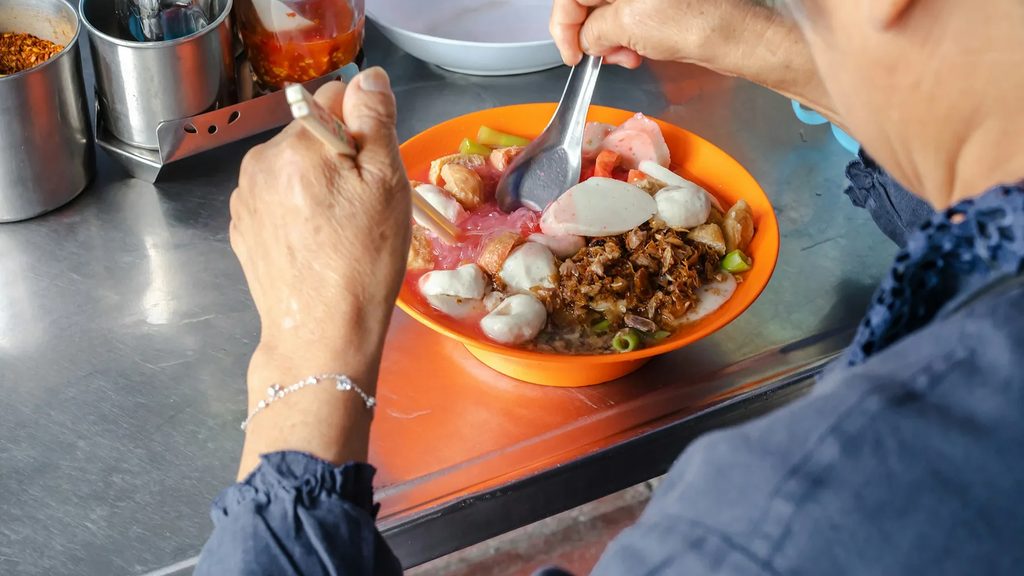
The Amazing Amphawa Food Experience gathers up to 60 vendors at the memorial park on the two festival weekends, 11–13 and 18–20 September. This is not generic Bangkok street food transplanted to a village. Samut Songkhram's specialities are its own: grilled river prawns the size of your hand, hoy lai clams stir-fried with chilli paste, coconut sugar cooked down in open pans, pomelo from the orchards along the Mae Klong, and boat noodles served from actual boats.
Budget 60–150 baht a plate for most of it. Grilled prawns are the exception and are sold by weight — expect 400–700 baht for a portion for two. Mango sticky rice runs 60–80 baht. Bring cash; plenty of the boat vendors still do not take QR payment.
How to get to Amphawa from Bangkok
Amphawa is about 90 kilometres southwest of the capital and a genuinely easy half-day out from anywhere in central Bangkok.
- Minivan — from the Southern Bus Terminal (Sai Tai Mai) direct to Amphawa, roughly 80–100 baht and 90 minutes. The way most Thais do it.
- Bus to Samut Songkhram — slightly slower and cheaper, then a 20-baht songthaew or a short Grab into Amphawa itself.
- Grab or Bolt — around 1,200–1,800 baht each way from central Bangkok. Worth it for a group of four, and the only option that gets you home comfortably after 22:00.
- Train and boat — the slow, wonderful route via Wongwian Yai and the Maeklong Railway Market, where the awnings fold back as the train passes through. Half a day each way, and a piece of Thai culture in its own right.
The catch is the return leg. Public minivans thin out after about 20:00 and largely stop by 21:00, well before the festival closes. If you want the full evening, either pre-book a car or stay the night — which is the better plan anyway.
Staying over, and building it into a Thailand itinerary
Amphawa's homestays are the point. Wooden rooms on stilts over the canal, fan or air-conditioning, typically 700–1,800 baht a night, often with breakfast and a longtail boat ride to the temples included. During festival weekends they fill up, so book ahead rather than walking in.
For anyone doing serious Thailand vacation planning, Amphawa slots neatly into the western loop rather than being a there-and-back. Two obvious extensions: continue southwest to Hua Hin for the beach and the night market, or turn north to Kanchanaburi for the River Kwai and the Erawan waterfalls. A clean five-day Thailand itinerary from the capital would be two nights in Bangkok, one in Amphawa, two in Kanchanaburi — and not a single domestic flight.
Where this sits in the Thai festivals 2026 calendar
September is a quiet month for Bangkok tourism and a loud one for provincial culture, which is a good trade if you do not mind an afternoon downpour. Immediately after Amphawa closes, Bun Duean Sip runs in Sakon Nakhon from 20–26 September. Ok Phansa and the naga fireball night on the Mekong follow in October. The Phuket Vegetarian Festival takes over the old town in mid-October, and Loy Krathong and Yi Peng land on 24–25 November.
Put another way: the back half of the Thai festivals 2026 calendar is the strongest part of it, and it coincides with the end of the rains and the reopening of the Andaman Thailand islands. Anyone planning travel to Thailand for late 2026 is looking at the right window — and should note the new 30-day visa-free rule that took effect on 15 September.
Practical tips for the last nights
- Arrive at 16:30, not 19:00. You get the market in daylight, the light installations switching on, and a table before the weekend crowd.
- Weekends are bigger, weekdays are quieter. The 60-vendor food zone and the stage programme only run again on 18–20 September.
- Carry small notes. Boat vendors, songthaews and most homestays are cash-first.
- Bring an umbrella. Mid-September afternoons in Samut Songkhram reliably produce one short, heavy shower.
- Mind the canal edge. There is no railing in places and it is dark. Watch children closely.
- Firefly boat tours leave around 19:00 for roughly 60–100 baht a head. Sightings drop off sharply in bright moonlight, so treat it as a bonus rather than the reason you came.
There is a specific pleasure in arriving somewhere for a festival that was not designed for you. Of everything on the Thai festivals 2026 calendar, this is among the least packaged: Neramit Amphawa was built for Thai weekenders from Bangkok, and the handful of foreign visitors who find it will be walking through a town doing what it has always done — selling food off boats — with the volume turned up and the lights on. Four nights left.
Sources
- Neramit Amphawa Amazing Thailand Food Festival showcases Samut Songkhram's 'city of three waters' — TAT Newsroom, 12 September 2026
- TAT lights up 9 Amphawa landmarks for September 11–20 — The Nation Thailand
- September Event and Calendar — TAT Newsroom