Ask a first-time visitor for the best places to visit in Thailand and the answer is usually Bangkok, Phuket or Ko Samui. Hua Hin rarely makes the shortlist — which is precisely what Thailand's government is now trying to change. In a travel feature published on 5 August 2026, the Tourism Authority of Thailand set out the case for the country's original royal seaside retreat as its next world-class destination, backed by an airport upgrade, new international routes and a deliberately un-crowded strategy.
For anyone in the middle of Thailand vacation planning, that matters. Hua Hin sits roughly 200 kilometres south-west of the capital on the Gulf of Thailand, close enough for a long weekend and quiet enough to feel like a different country from Sukhumvit.
Why Hua Hin has joined the best places to visit in Thailand
In July 2026, Tourism and Sports Minister Surasak Phancharoenworakul toured Hua Hin, Cha-am and the surrounding districts of Prachuap Khiri Khan and unveiled a plan to put the resort alongside Phuket and Ko Samui on every list of the best places to visit in Thailand. Rather than chasing volume, officials are leaning into what makes the town distinctive: a calmer pace, royal heritage and an established following among repeat visitors.
The centrepiece is air access. The government is pushing to reopen Hua Hin Airport to international traffic, with runway expansion and terminal upgrades targeted for completion by the end of 2026, and is courting carriers to fly direct from Kuala Lumpur, Taipei, Shanghai and Singapore. TAT has also signed a three-year partnership with Thai AirAsia, framing the approach as “value over volume” — higher-spending travellers rather than raw arrival numbers. Provincial authorities are backing it with a “Royal Destination” branding campaign.
- What changes for you — if the routes land, Hua Hin becomes reachable without a Bangkok transfer for the first time.
- What has not changed yet — the airport is not open to scheduled international flights today. Every arrival still comes via Bangkok.
- Why go now — prices and crowds tend to move after the flights do, not before.
A century of Thai culture on the Gulf coast
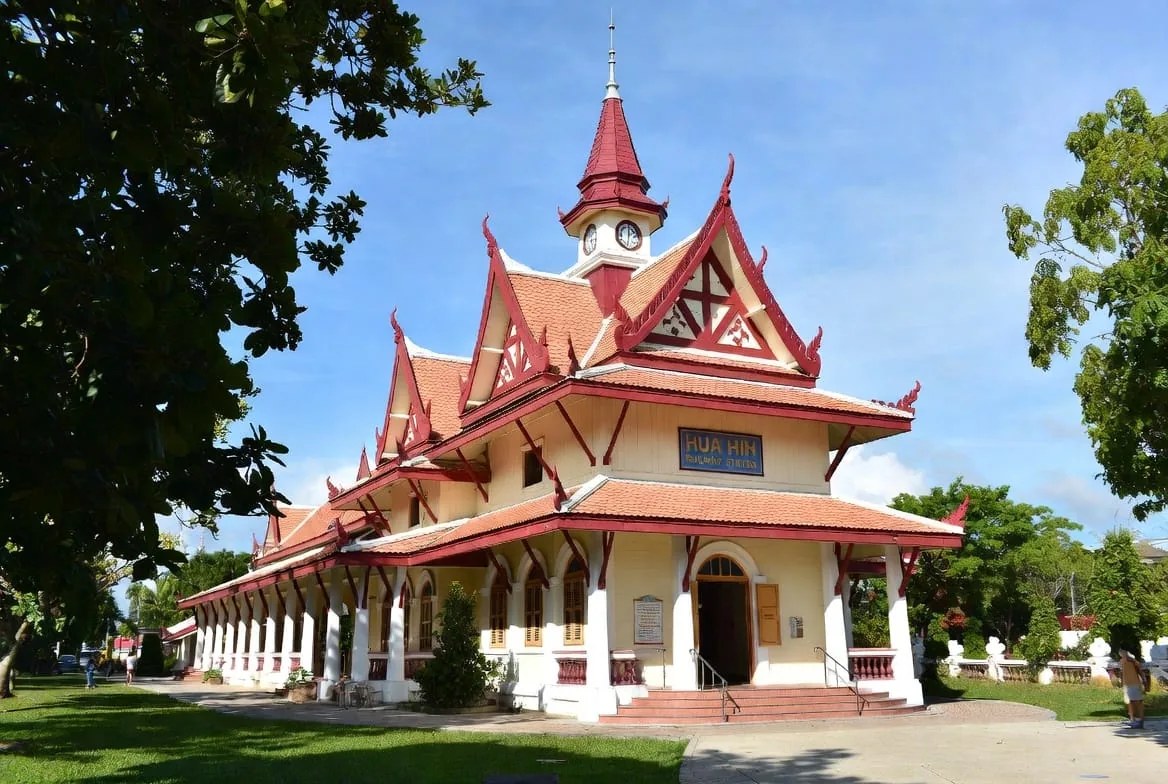
Hua Hin began in 1834, when farmers fleeing drought in neighbouring Phetchaburi settled a stretch of coast they called Samo Riang. A railway made it famous. When the Southern Line was completed in 1911, Siam's aristocracy reached a coastline they had never seen.
Prince Purachatra Jayakara championed its development. Construction of The Railway Hotel began in 1921 and it welcomed its first guests in 1922 — the same year King Rama VI commissioned Thailand's first golf course here. King Rama VII completed the summer palace Klai Kangwon, meaning “far from worries”, in 1929. That original hotel survives as the Centara Grand Beach Resort & Villas, its colonial silhouette still evoking steam trains and sea breezes. It is an unusually legible slice of Thai culture: walk the station platform, the hotel garden and the beach in one morning and you have watched the Thai beach holiday being invented.
How to travel to Thailand's original beach town
Until the airport opens, the journey is overland and easy. Allow three to four hours from central Bangkok, longer on Friday evenings and public holidays. Fares below are approximate and change; check current schedules before you book.
- Train — the Southern Line from Krung Thep Aphiwat runs to Hua Hin's heritage station in roughly 4 to 5 hours, from under 100 baht in third class to several hundred in second-class air-conditioned seats. The State Railway also runs occasional Royal Blossom luxury excursions.
- Bus and minivan — frequent departures from Bangkok's Southern Bus Terminal (Sai Tai Mai), roughly 180 to 300 baht, about 3 to 3.5 hours.
- Airport coach — direct services link Suvarnabhumi with Hua Hin for roughly 300 to 350 baht: the simplest option on arrival day.
- Private car or Grab — door to door in about three hours, usually 2,500 to 3,500 baht for the car.
- Getting around — songthaews run the beach road for 10 to 20 baht a hop, Grab and Bolt both operate, and scooters rent for roughly 200 to 300 baht a day.
Things to do, from night markets to vineyards
Hua Hin's appeal is that it is a working town with a beach rather than a resort strip. The seafood is the headline — Gulf prawns, squid and whole fish grilled at the night market, at prices that still surprise people arriving from Phuket.
- Cicada Market — weekend arts, crafts and live music, best from about 5pm.
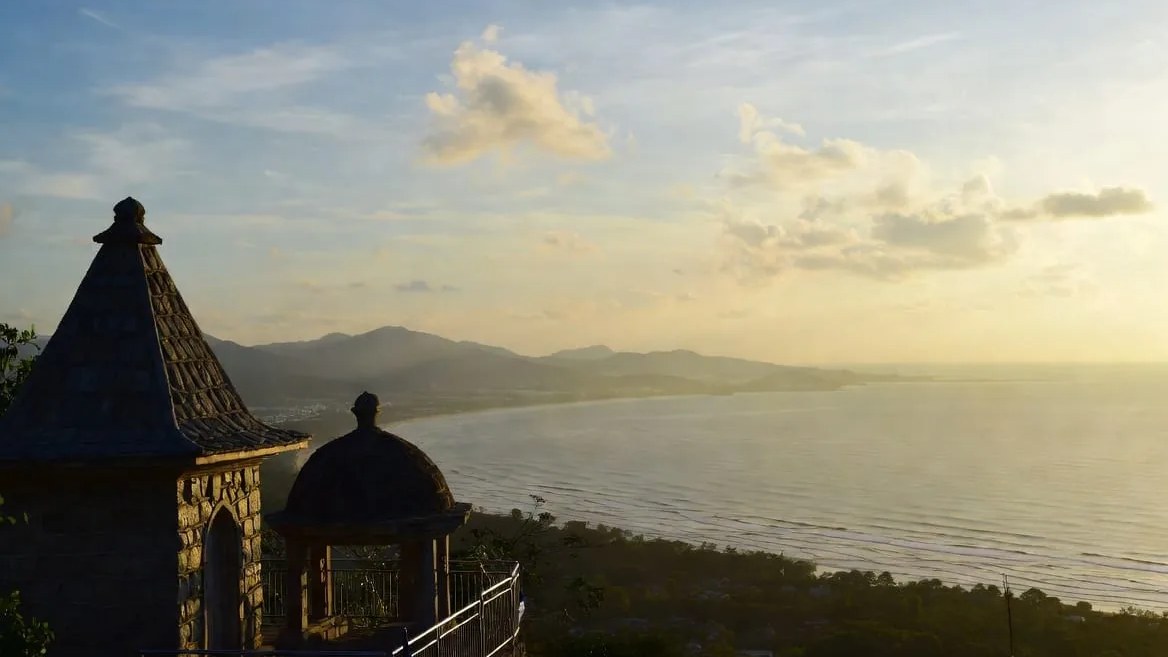
- Khao Takiab — the “Chopstick Hill” headland at the south end of the bay, with a hillside temple, resident macaques and the viewpoint at the top of this page.
- Wat Huay Mongkol — a giant statue of the revered monk Luang Pu Thuat, about 15 kilometres inland.
- Monsoon Valley Vineyard — Thailand's best-known winery, with a restaurant among the vines and highly rated Shiraz and Colombard.
- Golf and wellness — a dozen championship courses, the 1922 royal course among them, plus the long-established Chiva-Som retreat.
- Vana Nava Water Jungle — the region's largest water park, and the easiest win of the trip if you are travelling with children.
Two events are worth planning around: the Hua Hin Jazz Festival on the beach in late May and June, honouring the late King Bhumibol Adulyadej's own passion for the saxophone, and the Hua Hin International Kite Festival.
Where Hua Hin fits in a Thailand itinerary
The obvious pairing is with the capital. Three or four days of temples, canals and Bangkok street food, then a train south for four nights of beach and early swims, makes a relaxed week-long Thailand itinerary with no domestic flight in it. Our Bangkok guide and Hua Hin guide cover both ends in detail.
The best places to visit in Thailand are rarely a single stop, though, and the eastern seaboard makes an easy comparison. Pattaya is closer to Bangkok, louder and built for day trips — the ferry to Koh Larn's beaches takes 45 minutes, and there is no shortage of things to do in Pattaya after dark. For proper Thailand islands with clear water, from Koh Kood to Koh Tao, you are still heading further south. Hua Hin works best as the calm bookend to those trips.
Best time to visit and practical tips
November to March is the reliable window — dry, breezy, comfortably warm, and peak season across most of the best places to visit in Thailand. August sits in the green season, but Hua Hin is noticeably drier than the Andaman coast at this time of year, with rain arriving as short late-afternoon downpours rather than all-day weather.
- Book weekends early — Hua Hin is Bangkok's own beach, so Friday and Saturday nights fill first and cost the most. Arrive on a Sunday and pay less.
- Swim in the morning — the tide is usually kindest early, and the beach is at its emptiest before nine.
- Carry small notes — night market stalls, songthaews and temple donations are all cash.
- Check Pa La-U before you drive — the waterfall inside Kaeng Krachan National Park, a popular half-day trip inland, was closed after flash flooding in July 2026 and had no announced reopening date at the time of writing.
- Watch the airport news — if you are planning for 2027, direct regional flights would change both the price and the shape of the trip.
Thailand's beach map has been redrawn several times, and each redraw starts with a piece of infrastructure. In 1911 it was a railway line. In 2026 it may well be a runway. If you want to see one of the best places to visit in Thailand before the direct flights arrive, this is the window.
More Thailand travel news
Sources
- Hua Hin is Where Royal Legacy Meets the Gulf of Thailand — TAT Newsroom, 5 August 2026
- Pa La-U Waterfall closed after flash floods in Kaeng Krachan — The Nation Thailand, 12 July 2026
- August 2026 Event and Calendar — TAT Newsroom, July 2026