Chiang Mai Flower Festival
- 🌿 Flower floats
- 📸 Very photogenic
- 👨👩👦 Family friendly
- 🎭 Lanna north
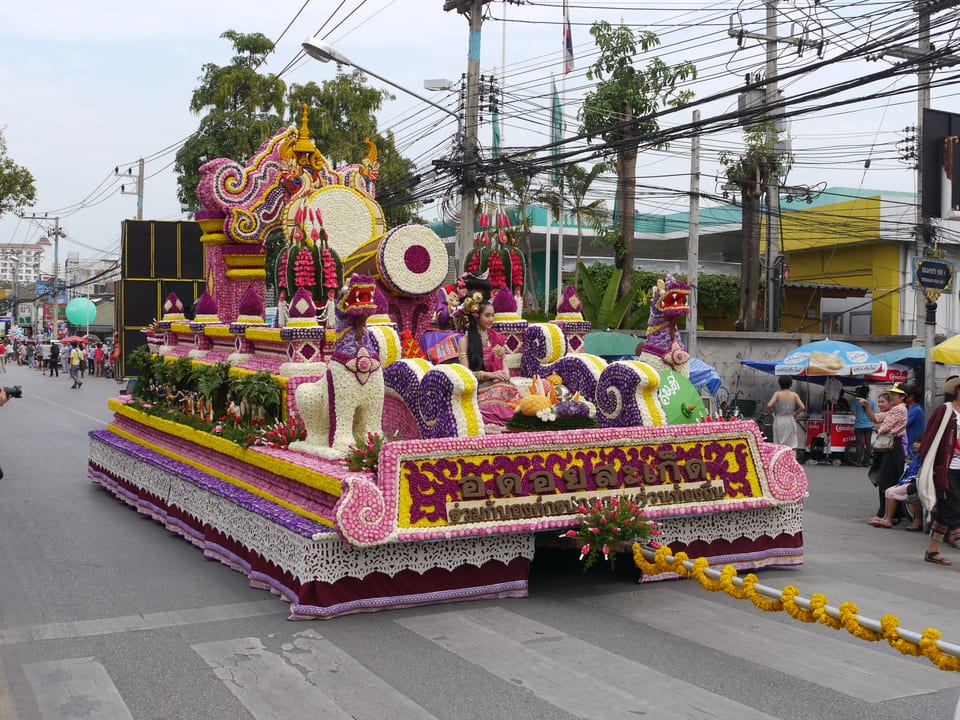
On the first weekend of February, when the northern cool season is at its best and the whole region is in bloom, Chiang Mai builds a parade out of flowers. The floats are enormous — several metres high, carried on lorries, covered entirely in chrysanthemums, orchids, marigolds and damask roses — and they take days to assemble. It is among the most purely pleasant festivals in Thailand, with nothing to brace yourself for.
What happens
The festival centres on Suan Buak Hat, the park at the south-west corner of the old city moat, which fills with flower displays, horticultural competitions and plant stalls for the weekend.
The main event is the parade on Saturday morning, when the floats process from the park along the moat and through to Tha Pae Gate, accompanied by marching bands, Lanna dancers in traditional dress and the festival’s beauty contest finalists.
The flowers themselves are the point. Northern Thailand’s cool-season climate supports varieties that will not grow in the rest of the country, and the festival is partly an agricultural showcase for the province’s growers.
When it happens
The festival is fixed to the first weekend of February, so unlike the lunar festivals you can plan around it years ahead.
| Year | Dates | Notes |
|---|---|---|
| 2027 | 5–7 February | Parade on the Saturday morning |
| 2028 | First weekend of February | Set by the rule; confirmed by the city closer to the date |
Getting the most out of it
The parade is on the Saturday morning and starts early. Get a spot along the route before it begins rather than trying to find one once the floats are moving.
The floats take days to build and the construction is worth seeing in its own right. Walk through Suan Buak Hat park on the Thursday or Friday to watch the work in progress with no crowds at all.
February is the start of Chiang Mai’s burning season in the surrounding countryside. Air quality is usually still reasonable this early, but it deteriorates sharply through March, so this is close to the last comfortable month in the north.
What else is on
February is arguably the best month to be in Chiang Mai. The weather is dry and cool, the countryside is green after the rains, and the north has not yet gone into burning season.
The Bo Sang Umbrella Festival runs a couple of weeks earlier in January just outside the city, and the two pair well if your dates are flexible. Doi Suthep, the Sunday Walking Street and the craft villages around San Kamphaeng are all at their best in this window.
Getting there
From Bangkok: Hourly flights to Chiang Mai (CNX) from both Bangkok airports. February is high season but this festival does not cause the sell-outs that Yi Peng does. 1 hr 20 min.
From Chiang Mai Airport: Grab or songthaew to the old city, about fifteen minutes. Suan Buak Hat park sits at the south-west corner of the moat. 15 min.
From within Chiang Mai: The whole festival is walkable from anywhere inside or just outside the old city walls. Walkable.
Watching the floats being built
The best-kept secret of this festival is the two days before it. The floats are assembled at Suan Buak Hat in the open, and walking through while teams wire thousands of individual blooms onto the frames is quieter, more interesting and far better for photographs than the parade itself.
Go on the Thursday or Friday afternoon. There is no crowd, no barrier, and the growers are generally happy to talk about what they are doing.
Making a weekend of it
February is the best month of the Chiang Mai year, and the festival is only a morning of it.
The Sunday Walking Street along Ratchadamnoen runs the same weekend and is the best market in the city. Doi Suthep is at its clearest before the haze arrives. The craft villages out along the San Kamphaeng road — silk, silver, celadon, lacquer — are a half day, and the Bo Sang umbrella workshops at the end of that road are open year-round even though their own festival is in January.
For a day out of the city, Doi Inthanon and the Mae Sa valley are both at their best in cool season.
What it costs
The festival is free, including the parade and the park displays. February is high season so flights and hotels are at their annual peak, but this festival does not add to that the way Yi Peng does in November — rooms are available at normal high-season rates rather than triple.
Plants and flowers at the park are sold at grower prices, which is of limited use to a traveller but explains why half the crowd is Thai and carrying trays of seedlings.
Why go
Because it is beautiful, free, relaxed and entirely without the logistical headaches that come with Thailand’s bigger festivals. Nobody will throw water at you, nothing starts at 4am, and you do not need to book a year in advance.
If you want one northern festival and the November crush of Yi Peng does not appeal, this is the alternative — a smaller, gentler, considerably cheaper weekend in the same city.