Bo Sang Umbrella Festival
- 🎭 Lanna craft
- 📸 Extremely photogenic
- 👨👩👦 Workshops
- 🚇 Day trip
Bo Sang is a village of umbrella makers about nine kilometres outside Chiang Mai, and for one weekend each January it hangs every available surface with hand-painted parasols. Shopfronts, trees, fences, bicycles and motorbikes all get decorated. It is one of the most photogenic small festivals in Thailand and one of the least visited by foreigners.
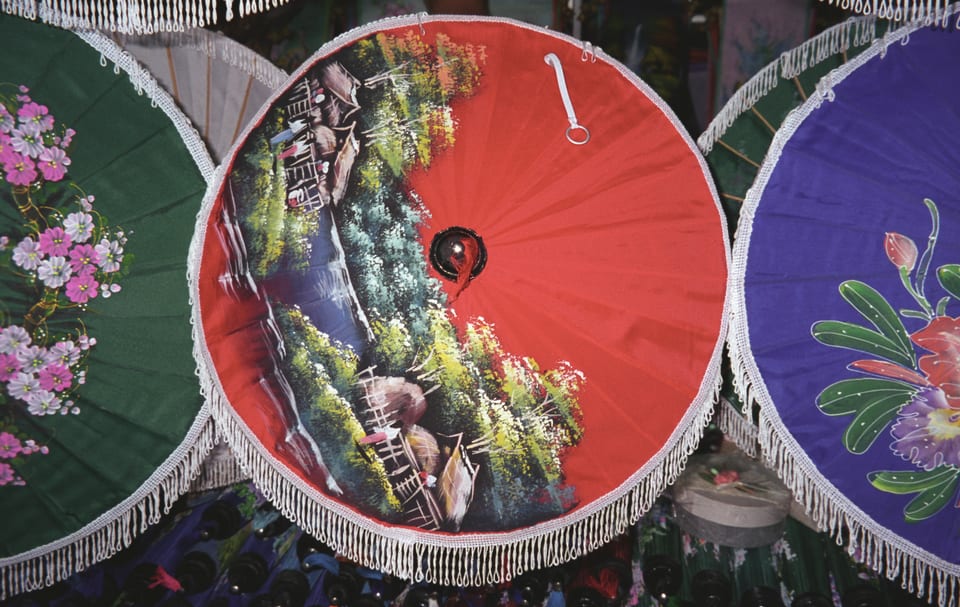
The craft
Bo Sang parasols are built on a bamboo frame and covered in saa paper made from mulberry bark, then hand-painted — traditionally with flowers, birds and dragons, though the workshops now produce silk and cotton versions and a wide range of modern designs.
The tradition is credited to a local monk, Phra Inthaa, who brought the technique back to the village more than a century ago. It is still an economic mainstay here rather than a heritage performance, which is why the festival feels like a village celebrating its own trade rather than a show staged for visitors.
What happens
The main street is decorated end to end, and the workshops open up so you can watch each stage of the process — splitting bamboo, assembling frames, stretching the paper, painting.
There is a parade with decorated bicycles and motorbikes, traditional Lanna dress and a beauty contest, cultural performances, a traditional market and food stalls. Visitors can usually paint a small parasol themselves for a modest fee, which makes this an unusually good festival for children.
When it happens
The festival has run on the third weekend of January since the 1980s, which makes it one of the few Thai festivals you can plan around years ahead.
| Year | Dates | Notes |
|---|---|---|
| 2027 | Third weekend of January | Fixed by the rule; confirmed locally each year |
| 2028 | Third weekend of January | — |
Making the most of it
Go in the afternoon. The parade and the main activity are later in the day, and the morning is quiet.
The festival is small and genuinely local — a village street, not a city event. Come for an afternoon, not a whole day, and combine it with the other San Kamphaeng craft workshops along the same road.
The Bo Sang Umbrella Centre is open year-round if your dates do not line up. You will miss the decorations and the parade but still see the parasols being made.
Getting there
From Chiang Mai: Bo Sang is around 9 km east of the city on the San Kamphaeng road. Songthaews run the route regularly, or it is a short Grab ride. The craft villages continue along the same road. 20–30 min.
From Bangkok: Fly to Chiang Mai (CNX) and base yourself in the city — there is no reason to stay in Bo Sang itself. 1 hr 20 min.
The San Kamphaeng road is Chiang Mai's craft corridor — silk weaving, silverwork, lacquerware and celadon workshops run the length of it — so it is worth continuing east after the festival rather than turning straight back.
How the parasols are made
Watching the process is the point of coming, and every stage happens in the open during the festival.
Bamboo is split and shaped into ribs and a sliding collar. Saa paper, made from mulberry bark, is cut and glued over the frame while it is open. The surface is coated to stiffen and waterproof it. Then it is hand-painted, freehand, usually in a few minutes by someone who has done it ten thousand times.
The painters will decorate almost anything you put in front of them — bags, phone cases, shirts — which is a better souvenir than another parasol and takes about two minutes.
The San Kamphaeng craft road
Bo Sang sits on the road that holds most of Chiang Mai's traditional crafts, and the festival is a good excuse to work along it.
Silk weaving, silverwork, celadon pottery, lacquerware and woodcarving workshops all run between the city and San Kamphaeng, most of them open to visitors with no entry charge. The San Kamphaeng hot springs are at the far end.
Hiring a car or a driver for the afternoon costs little and turns a village festival into a full day.
What it costs
Free to attend. A painted parasol costs a few hundred baht depending on size, and the painting workshops are a nominal fee. Transport from Chiang Mai is a songthaew fare.
January is cool-season high season in the north, so flights and hotels are at their peak — but the festival itself adds nothing to that, and Bo Sang draws nowhere near the crowds that February's flower festival does.
Why go
Because January in Chiang Mai is close to perfect — dry, cool, clear, well before the burning season — and because this is the kind of small, specific, unhurried festival that the big names crowd out.
If you are in the north in early February instead, the Chiang Mai Flower Festival occupies much the same niche a couple of weeks later.