World Wai Kru Muay Thai Ceremony
- 🏁 Muay Thai
- 🎭 Ritual ceremony
- 📸 Temple ruins
- 🚇 Day trip
Each March, several hundred Muay Thai fighters from dozens of countries gather among the ruins of Ayutthaya and perform the wai kru ram muay in unison — the ritual dance by which a fighter pays respect to their teacher, their lineage and the ring before fighting. It is a small festival with an intensely motivated audience, and it is one of the few events in Thailand that people travel specifically to take part in rather than watch.
What the wai kru is
Before any Muay Thai bout, a fighter performs the wai kru ram muay: a sequence of movements that seals the ring, honours the teacher who trained them, and settles the mind. It is not a warm-up. It is an act of respect with real weight in the sport, and most fighters learn a version specific to their camp.
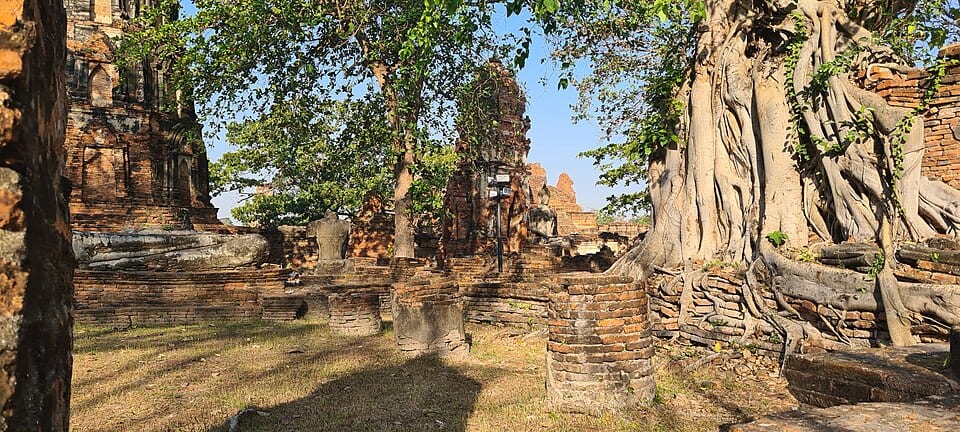
The World Wai Kru ceremony takes that private ritual and performs it en masse, in the former capital of the kingdom where the sport took its modern shape. Practitioners kneel in rows among the ruins and move through the sequence together, with drums and pi chawa oboe accompaniment.
What happens
Alongside the mass ceremony there are demonstrations of traditional Muay Boran techniques, exhibition bouts, weapon forms, and ceremonies honouring senior masters. Many participants take initiation into a camp or lineage during the event.
Ayutthaya is the setting for a reason. The city was the capital when Muay Thai developed as a battlefield and court discipline, and the national Muay Thai day commemorates Nai Khanom Tom, the fighter of Ayutthaya legend who is said to have defeated a succession of Burmese opponents in captivity.
When it happens
The ceremony is held in mid-March, around National Muay Thai Day on 17 March.
| Year | Dates | Notes |
|---|---|---|
| 2027 | Mid-March | Held around National Muay Thai Day, 17 March |
| 2028 | Mid-March | — |
Worth knowing
This is a ceremony, not a fight card. There are demonstrations and exhibition bouts, but the centrepiece is hundreds of practitioners performing the wai kru ram muay together. If you came expecting a tournament, you will be disappointed.
March in central Thailand is hot and the historical park has little shade. Start early, bring water, and plan the afternoon around somewhere indoors.
Dates are announced annually and cluster around National Muay Thai Day on 17 March. Confirm before travelling.
Getting there
From Bangkok: Frequent trains from Krung Thep Aphiwat to Ayutthaya. Cheap, straightforward, and the station is a short ride from the historical park. 1.5–2 hrs.
From Bangkok: Minivans from Mo Chit, or about ninety minutes by car. 1.5 hrs.
From Ayutthaya station: Tuk-tuk or bicycle to the historical park. The ruins are spread out, so hiring a bike for the day is the usual approach. 10–15 min.
Ayutthaya deserves the day regardless. The historical park is a UNESCO World Heritage site, and Wat Mahathat, Wat Chaiwatthanaram and Wat Phra Si Sanphet are all within easy cycling distance of each other.
Taking part
Registration is open to practitioners from abroad, and this is the main reason people travel for it. Fighters from dozens of countries register to perform the mass wai kru, and many camps organise group trips around the dates.
Participants typically receive a mongkhon headband and prajioud armbands as part of the ceremony, and some take formal initiation into a lineage. If you train, ask your gym — most Thai camps know how the registration works and several bring students every year.
If you do not train, it is free to watch and nobody will mind you being there.
Ayutthaya in a day
The ceremony occupies a morning, which leaves the former capital for the rest of it.
Wat Mahathat holds the sandstone Buddha head grown into the roots of a fig tree, the most photographed object in the city. Wat Chaiwatthanaram on the river is the most complete complex and the best at sunset. Wat Phra Si Sanphet was the royal temple and its three chedis are the image on most Ayutthaya postcards.
Hiring a bicycle at the station is the standard approach — the park is flat and the ruins are close together.
What it costs
The ceremony is free to watch; registration to take part carries a fee. Trains from Bangkok cost very little and run frequently.
Entry to the individual temple ruins is modest, and a combination ticket covers the main sites. Most people do this as a day trip and spend almost nothing beyond transport and entry fees.
Why go
If you train Muay Thai, this is a pilgrimage and you already know whether you want to be there. Registration to take part is open to practitioners from abroad and plenty of camps organise trips around it.
If you do not, it is still a striking thing to witness — hundreds of people performing the same slow ritual among six-hundred-year-old brick ruins — and it costs nothing but a train fare from Bangkok.