Surin Elephant Round-Up
- 🐘 Hundreds of elephants
- 🎭 Kui mahout heritage
- 🍜 Elephant breakfast
- 📸 Big spectacle
Surin province in Isaan holds the largest population of domesticated elephants in Thailand, and once a year several hundred of them come into town. There are processions through the streets, a morning banquet laid out for the elephants on long tables, and shows in a purpose-built stadium. It is the biggest event of its kind in the country and also the one most likely to leave you with mixed feelings.
What happens
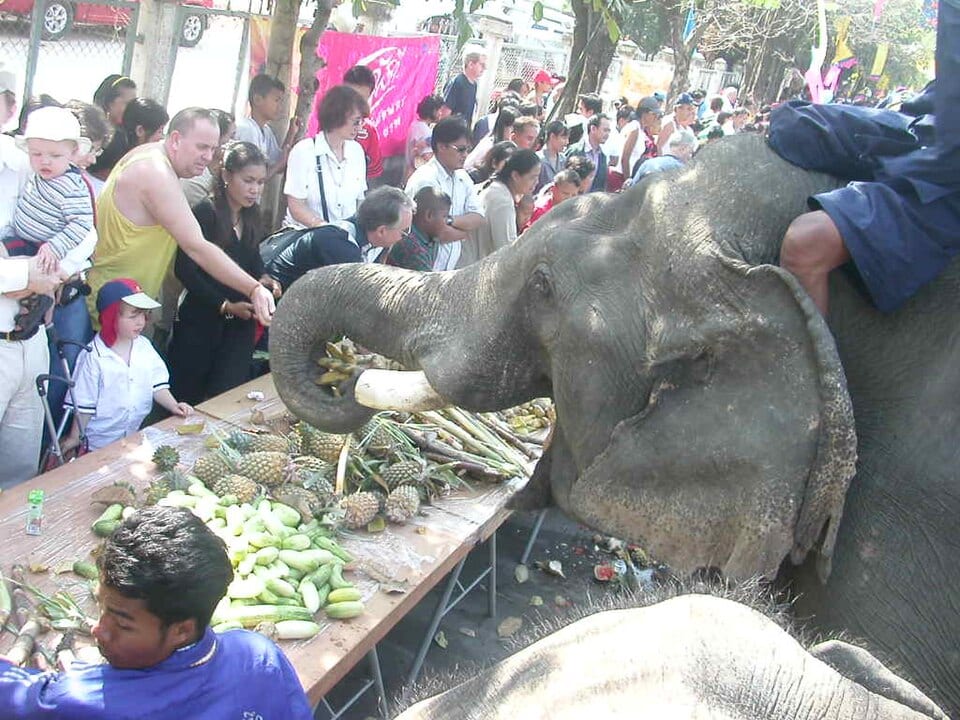
The festival opens with the elephant breakfast, the image that travels furthest: tables laid the length of a street with tonnes of fruit, vegetables and sugar cane, and a long line of elephants working their way down it while the town watches.
There are street processions with elephants in ceremonial dress, demonstrations of traditional capture and training techniques by the Kui mahouts, and performances at the Surin Elephant Stadium that in past years have included re-enactments of historic battles, parades and games.
Around all of it is a provincial fair — food, stalls, music and a town that is visibly pleased to have everyone there.
When it happens
The Round-Up is held in the second half of November, with the main programme over a weekend and the breakfast on the opening day.
| Year | Dates | Notes |
|---|---|---|
| 2026 | 19–21 November | Elephant breakfast buffet on the opening day |
| 2027 | Mid-to-late November | Confirmed by Surin Province closer to the date |
The welfare question, straight
This festival involves captive elephants performing for crowds — processions, stadium shows, and in some years displays including tug-of-war and football. Many visitors find parts of it uncomfortable, and major animal welfare organisations oppose performance events of this kind. You should decide what you are comfortable attending before you travel, not when you are in the stand.
The counter-argument matters too and is rarely heard. Surin's Kui people have worked with elephants for centuries, the province is home to Thailand's largest population of domesticated elephants, and the festival is a significant part of how mahout families earn a living. The event is also where many of those elephants and their keepers reconnect each year.
If you would rather not attend the stadium shows, the street processions and the morning buffet are free, outdoors, and a much gentler way to see the elephants.
The Kui and the elephants
Surin's association with elephants is not a tourist invention. The Kui (or Suay) people have been elephant catchers, trainers and keepers in this region for generations, and the village of Ban Ta Klang, about an hour from Surin town, is the centre of that culture. Families there live alongside their elephants year-round.
That history is also why the welfare conversation around this festival is more tangled than it first appears. These are working animals within a living tradition, in a province whose economy has been shaped by them — which is not the same thing as a tourist camp set up last year, and not an answer to every objection either.
If you want to understand the context rather than just watch the show, Ban Ta Klang and the Elephant Study Centre are worth the drive.
Getting there
From Bangkok: Direct trains from Krung Thep Aphiwat to Surin, including overnight sleepers. The station is in the middle of town and walkable to the procession route. 7–9 hrs.
From Bangkok: Buses from Mo Chit run through the day and overnight. 7–8 hrs.
From Buriram or Ubon Ratchathani: Fly to Buriram (BFV) or Ubon Ratchathani (UBP) and drive in — both are a reasonable road connection and much faster than the train from Bangkok. 1 hr flight + 1–2 hrs road.
Surin is a long way from anywhere on the usual tourist route, and accommodation in town is limited and fills for the festival. Book well ahead or stay in Buriram and drive in.
What a visit involves
The breakfast is on the opening day, in the street, free to watch, and over by mid-morning. Get there early; it is the most photographed part of the festival and the crowd builds fast.
The stadium shows are ticketed and run across the weekend. Seats are sold in advance and on the day, and this is the part of the festival most visitors have reservations about — see the note above.
The street processions are free and outdoors, and give you the scale of the thing without the stadium setting.
Around all of it, Surin runs a provincial fair with Isaan food, music and market stalls that is worth an evening in its own right.
Ban Ta Klang
If the festival raises questions for you, the answer to most of them is about an hour north at Ban Ta Klang, the Kui elephant village. Families here live alongside their elephants year-round, and the Elephant Study Centre explains the history of the relationship better than anything at the stadium will.
Going there turns a weekend of watching performances into something closer to understanding why this province has the elephants it does. It is also open all year, so it works as a reason to visit Surin outside November.
What it costs
The breakfast and processions are free; stadium seats are ticketed and modestly priced. The real cost is getting there and sleeping — Surin's limited hotel stock fills for the festival and prices rise accordingly. Trains from Bangkok are cheap but slow; flights into Buriram or Ubon are faster and need booking early.
Why go, and why you might not
Go if you want to see something that is still fundamentally a provincial Thai event rather than an international one, and if the scale of it — hundreds of elephants in one town — is the draw.
Think carefully if performance animals trouble you. Nothing here is hidden; it is exactly what it looks like, and plenty of visitors come away glad they went while still being uneasy about parts of it. That is a reasonable reaction and worth anticipating before you spend eight hours on a train.