Songkran
- 💦 Nationwide water fight
- 🎉 Biggest festival
- 🎭 Thai New Year
- 👨👩👦 Everyone takes part
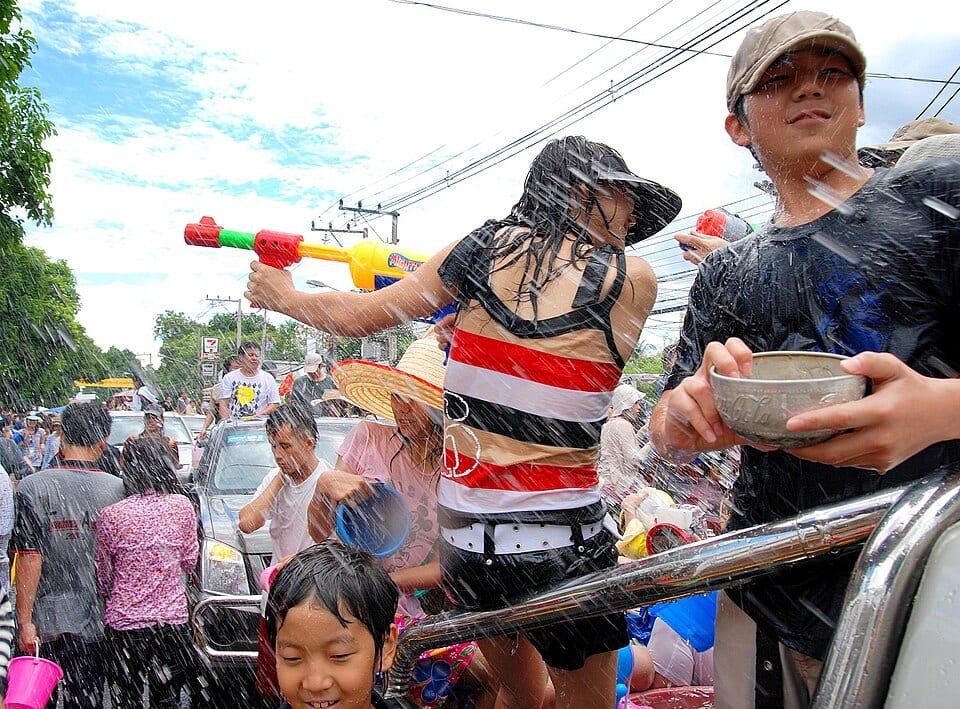
Songkran is Thai New Year, and for three days in the hottest week of the year the entire country throws water at itself. It is the largest festival in Thailand by a wide margin, it is impossible to avoid if you are in the country, and it is either the best thing that will happen to you in Thailand or a reason to plan your trip around different dates. There is not much middle ground.
What it actually is
Underneath the water fight is an old new-year ritual. Water is poured over Buddha images to bathe them, and younger people pour scented water over the hands of parents and elders — rot nam dam hua — as a mark of respect and a request for blessing. Chalk paste is smeared on cheeks for luck. Houses get cleaned out, debts get settled, families travel home.
The street battle grew out of that gesture and has comprehensively overtaken it. Both still happen, often in the same street within an hour of each other, and the quiet version is the one almost no visitor sees because it takes place in temples and family homes in the morning.
When it happens
Unlike almost every other festival in Thailand, Songkran does not move. It is 13–15 April, every single year.
| Year | Dates | Notes |
|---|---|---|
| 2026 | 13–15 April | — |
| 2027 | 13–15 April | Public holiday; the dates never move |
| 2028 | 13–15 April | — |
| 2029 | 13–15 April | — |
In practice it runs longer. Many areas start a day early and keep going for most of a week, and some provinces have their own extended versions — Wan Lai in Chonburi continues after the national holiday has finished.
Practical survival notes
Your phone will get soaked unless it is in a sealed pouch. Buy a waterproof neck pouch on day one — they are sold on every corner — and assume anything not inside it is finished. The same goes for passports, cash and camera gear.
Water is thrown by everyone at everyone, from pickup trucks, buckets, hoses and super-soakers, often with ice in it. There is no opting out in a water zone. If you do not want to take part, stay out of those streets entirely, because walking through dry is not an option anyone will respect.
Road deaths spike dramatically over the Songkran holiday — Thai media call it the “seven dangerous days”. Drink-driving and motorbikes are the main causes. Do not rent a scooter over these dates, and take care crossing roads where visibility is cut by water.
Transport and hotels are booked out nationwide and prices rise accordingly. Domestic flights, trains and buses sell out weeks ahead as the whole country travels home.
Where to go
Chiang Mai is the consensus best. The old city moat provides an inexhaustible water supply, the whole ring road becomes one continuous battle, and the city keeps its processions and temple rituals alongside it. It is also completely booked out months in advance.
Bangkok concentrates into zones. Silom becomes a closed road with a crowd running its full length, Khao San is the backpacker epicentre, and RCA runs a huge ticketed party. Most residential neighbourhoods are far gentler.
Pattaya is a special case because of Wan Lai, which extends the festival by several days and finishes on 19 April, after the rest of the country has dried off.
Smaller towns and villages give you the version with the rituals still intact — temple visits in the morning, gentle water in the afternoon, and nobody firing a pressure hose into your face from a moving pickup.
How to handle it
Accept that you will be wet from the moment you step outside until you come back in. Wear quick-drying clothes and sandals you do not mind ruining. Buy the waterproof pouch. Keep your mouth closed when you get hit — the moat and canal water is not clean.
Sunglasses are genuinely useful, both against ice water and against the chalk paste. Take cash in a sealed bag rather than a card you will have to dry out later.
If you want to see the respectful side, go to a temple on the morning of the 13th before the streets fill. That part of Songkran starts early and is over by the time the water starts.
Getting there
From anywhere in Thailand: You do not travel to Songkran. It happens wherever you already are, including the pavement outside your hotel.
From Bangkok: Silom and Khao San are the two heaviest zones in the capital. The BTS still runs, but staff will turn you away if you are soaking wet, so carry a dry layer. Citywide.
From Chiang Mai: The moat around the old city becomes the water supply and the whole ring road becomes the battle. Widely considered the best Songkran in the country. Walkable.
What it costs
Songkran itself is free. Everything around it is not.
Domestic flights over the holiday run at two to three times normal fares and sell out weeks ahead, as the entire country travels home at once. Hotel rates in Chiang Mai, Bangkok and Pattaya rise sharply, and many places impose minimum stays of three or four nights.
Budget for a waterproof pouch, a cheap pair of sandals, a water gun if you want one, and the accepted reality that you will buy more drinks than usual. None of that is expensive. The flights and the room are what cost money, and both are fixed by how early you book.
Banks, government offices and many small businesses close for the full three days. Withdraw cash before the 13th and do not plan anything that needs an office open.
Songkran city by city
Chiang Mai — the most complete version: moat, processions, temple rituals and a four-day street battle. The hardest to book and the most expensive.
Bangkok — concentrated into Silom, Khao San and RCA, with most of the city carrying on relatively normally. The easiest to dip in and out of.
Pattaya — starts late and finishes last, thanks to Wan Lai on 19 April. The best option if you cannot be here on the 13th.
Phuket — Patong is the focus and it is a young, heavily foreign crowd. Elsewhere on the island it is far quieter.
Ayutthaya — water fights with elephants joining in, which draws photographers and divides opinion on welfare grounds.
Should you plan around it?
If a three-day national water fight sounds like your idea of a holiday, build the whole trip around it and book months ahead. It is one of the great festivals on earth and nothing else in Asia feels like it.
If it sounds like a nightmare, check the dates before booking anything in April. There is no quiet corner of Thailand on 13 April, and arriving in Bangkok with luggage on that day is a genuinely unpleasant experience.