River Kwai Bridge Week
- 🎆 Light & sound show
- 🎭 WWII history
- 🍜 Night market
- 🚇 Easy from Bangkok
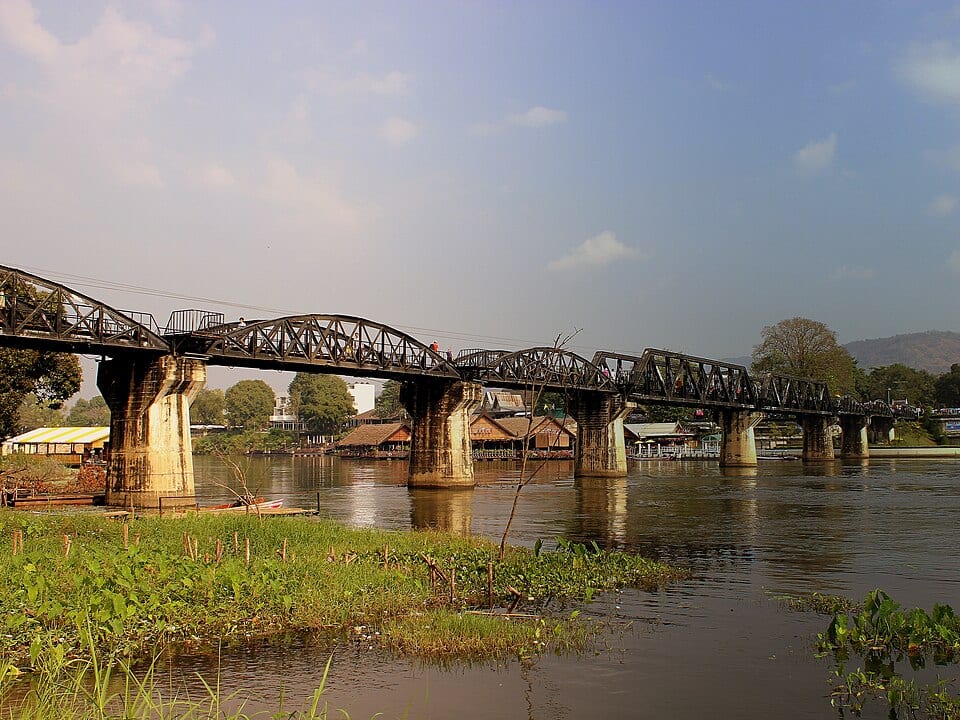
For eleven nights each year, the steel bridge that the Japanese army built across the Mae Klong with Allied prisoner and Asian forced labour becomes the backdrop for a light and sound show about its own construction and destruction. It is an unusual thing — a provincial fair, a Red Cross fundraiser and a war memorial happening in the same place at the same time — and it draws a very different crowd from most Thai festivals.
What the festival is
The centrepiece is the nightly light and sound show at the bridge itself. Over about forty minutes, narration and lighting tell the story of the Burma Railway — the Death Railway — its construction between 1942 and 1943, the conditions the labourers worked under, and the Allied bombing raids that eventually destroyed the span. The bombing sequence is staged with pyrotechnics against the real bridge, and it is the part everyone remembers.
Around the show is a full provincial fair: the Red Cross Fair, a large night market, stalls along the riverbank, rides and live music. Entry to the fairground and the market is free.
When it happens
Dates are set each year by Kanchanaburi Province and announced relatively late. The festival usually runs for about eleven nights from late November into early December.
| Year | Dates | Notes |
|---|---|---|
| 2025 | 27 November – 7 December | Held with the Red Cross Fair |
| 2026 | Late November into early December | Confirmed by Kanchanaburi Province closer to the date |
Practical notes
The light and sound show runs about forty minutes after dark, with narration in Thai and English. Seating has been free in recent years but is limited to roughly 1,200 places per show, so arrive early rather than turning up at the advertised start.
The show recreates the Allied bombing of the bridge with pyrotechnics and is genuinely loud. It is popular with families, but worth knowing if you are bringing small children or are sensitive to noise.
Kanchanaburi is a day trip from Bangkok, but the show is after dark and the last transport back leaves earlier than you would like. Plan to stay the night.
The rest of Kanchanaburi
If you are coming for the festival, come in daylight and give the town the afternoon. The Kanchanaburi War Cemetery holds nearly 7,000 graves and sits in the middle of town. The Thailand-Burma Railway Centre opposite it is a serious, well-made museum and the best single explanation of what happened here. Hellfire Pass, further out towards the Burmese border, is the most affecting site of all and has an excellent memorial museum run with Australian support.
Riding the surviving stretch of the railway north towards Nam Tok, along the wooden viaduct clinging to the cliff at Tham Krasae, is the other thing worth doing while you are here.
Many visitors arrive expecting the bridge from the film. The real bridge is not the wooden one David Lean blew up in The Bridge on the River Kwai, which was built for the camera in Sri Lanka; this one is steel, it was rebuilt after the war, and trains still cross it daily.
Getting there
From Bangkok: Trains to Kanchanaburi leave from <strong>Thonburi</strong> station, not Krung Thep Aphiwat or Hua Lamphong — a detail that catches people out. The fare is nominal and the line itself is part of the Death Railway. About 3 hrs.
From Bangkok: Minivans run frequently from Victory Monument, and buses from the Southern Bus Terminal at Sai Tai Mai. About 2 hrs.
From Kanchanaburi town: The bridge is a few kilometres north of the town centre. Songthaews run the route during the festival, or it is a flat cycle. 10–15 min.
Riding the Death Railway
The surviving stretch of line north from Kanchanaburi to Nam Tok is the single best thing to do here, festival or not. Trains run daily and the fare is nominal.
The section that matters is Tham Krasae, where a wooden trestle viaduct clings to a limestone cliff above the river — built by prisoners and labourers, still carrying trains. You can also walk it, and there is a cave shrine at the far end.
Going by train and returning by road, or the reverse, is the usual arrangement and takes most of a day.
Where to stay
Kanchanaburi has an unusual speciality: floating raft houses moored along the river, from very basic to genuinely comfortable. Sleeping on the water with the current under you is the thing people remember about the town.
Rooms fill during Bridge Week and prices rise, but the town has far more stock than somewhere like Surin, so booking a few weeks out is usually enough.
What it costs
The fairground, night market and light and sound show have all been free in recent years, with seating limited and first-come. Transport from Bangkok is inexpensive whichever way you travel, and the Nam Tok train costs very little.
Museum entry at the Thailand-Burma Railway Centre and Hellfire Pass is modest, and both are worth every baht. This is one of the cheapest festival trips in the country.
Why go
Because it is one of the few Thai festivals with a strong reason to attract British, Australian and Dutch visitors specifically — many of whom have a family connection to the railway — and because the combination of a war memorial and a funfair is stranger and more affecting than it sounds.
Come for the show, stay the night, and spend the day before it at the cemetery and the museum. The festival makes much more sense in that order.