Poy Sang Long
- 🎭 Shan tradition
- 🏮 Ordination rite
- 📸 Astonishing colour
- 🌿 Remote north
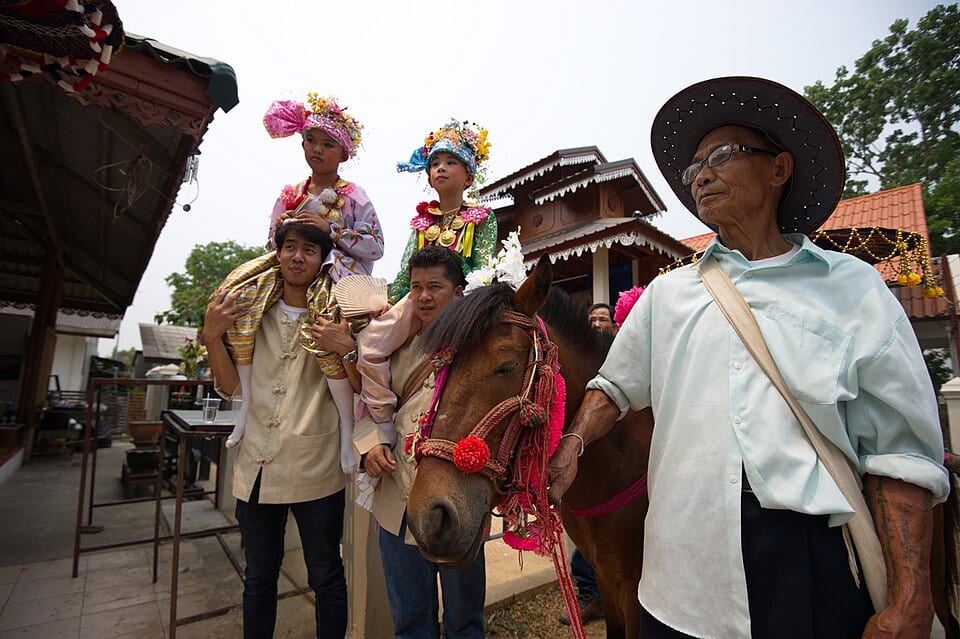
For a few days each spring, boys in Mae Hong Son are dressed in silk, jewellery, flowers and elaborate headdresses, painted with makeup, and carried through the town on the shoulders of their male relatives — feet never touching the ground — before their heads are shaved and they enter the monastery as novices. It is called Poy Sang Long, the festival of the Crystal Sons, and it is among the most visually extraordinary things that happens in Thailand.
What is happening
The boys are being ordained, usually between about seven and fourteen, in a Shan (Tai Yai) tradition. Mae Hong Son province sits against the Burmese border and has a large Shan population whose customs differ markedly from central Thai practice.
The costume has a specific meaning. The boys are dressed as princes in imitation of Prince Siddhartha before he renounced his royal life — which is precisely what they are about to do. Carried shoulder-high so their feet do not touch the ground, they are, for these few days, treated as royalty.
Then the jewels come off, their heads are shaved, they put on plain robes and they enter the temple. The contrast is the entire point of the ceremony.
The three days
Day one, Rub Sang Long, is when the boys are dressed and made up, and taken to pay respects at the temple and to town elders.
Day two, Kham Kaek, brings the main procession — the one everybody photographs — with parasols held over each boy, gongs, drums and the whole extended family in procession.
Day three is the ordination itself, when the boys request admission, the costume is removed and they become novices.
When it happens
There is no single date. Individual temples set their own, generally between late March and mid April, and the information circulates locally rather than being published.
| Year | Dates | Notes |
|---|---|---|
| 2027 | Late March to mid April | Each temple sets its own dates; Wat Pang Lo and Wat Hua Wiang are the main ones |
| 2028 | Late March to mid April | — |
Attend respectfully
This is a religious rite of passage for the families involved, not a performance. Boys are being ordained, often at seven or eight years old, and their families have saved for years to do it properly. Watch from the edge, ask before photographing a child close up, and do not block the procession.
Dates vary by temple and are not centrally published. Ask locally once you are in Mae Hong Son, or contact your guesthouse in advance — they will know which temples are holding ceremonies and when.
March and April are burning season in the far north and air quality in Mae Hong Son can be very poor. If you have respiratory problems, this is a real consideration rather than a minor one.
Getting there
From Chiang Mai: Short daily flights to Mae Hong Son (HGN). By far the easiest way in, and worth the fare. 35 min.
From Chiang Mai: The Mae Hong Son loop by road has 1,864 curves and takes most of a day. Spectacular, and genuinely nauseating if you are prone to motion sickness. 7–8 hrs.
From Pai: Mae Hong Son is the far end of the Pai road, so the two combine naturally into one northern trip. 3–4 hrs.
Mae Hong Son itself
The town is reason enough for the trip. It sits in a narrow valley close to the Burmese border, ringed by forested hills, with Wat Chong Kham and Wat Chong Klang reflected in the lake at its centre — both Burmese in style, lit at night, and unlike anything in central Thailand.
Wat Phra That Doi Kong Mu on the hill above gives you the whole valley, and is where the morning mist sits in the cool season.
The surrounding area has hot springs, Karen and Shan villages, and the Pang Ung reservoir, which is the one everybody photographs.
Getting the dates
There is no central listing, which is the single biggest obstacle to attending.
Temples set their own dates and the information circulates locally. The practical approach is to email a guesthouse in Mae Hong Son a month or two ahead and ask which temples are holding ceremonies and when — they will know, and they are used to the question.
Wat Pang Lo and Wat Hua Wiang are among the temples that hold ceremonies most years, and some villages outside town run their own.
What it costs
Free to attend. Mae Hong Son is inexpensive for food and accommodation, and the flight from Chiang Mai is short and reasonably priced.
The real cost is time. Getting there and back by road takes two days of your trip; flying costs more but gives you those days back. For a three-night stay in a remote valley, flying is almost always the better call.
Why go
Because almost nothing else in Thailand looks like this, and because Mae Hong Son is far enough off the route that you will be one of very few outsiders present.
Go for the town as much as the festival. Mae Hong Son sits in a valley ringed by forested mountains, with Burmese-style temples reflected in the lake at its centre, and it is among the most atmospheric places in the country whatever the time of year.