Phi Ta Khon Ghost Festival
- 🎭 Carved masks
- 📸 Unforgettable
- 🏮 Merit-making
- 🎉 Gleefully rude
In the small town of Dan Sai in Loei province, villagers put on towering masks carved from coconut-palm trunks and painted in extraordinary colours, strap bells to their backs, and spend three days roaming the streets as spirits. It is the strangest-looking festival in Thailand and among the most photographed, and almost nobody outside Thailand can tell you when it falls, because nobody knows until a few months beforehand.
What the masks mean
The festival belongs to a larger merit-making event called Bun Luang, combining two Isaan traditions: a rain rite and the Phra Wet ceremony, which recounts the Buddha's penultimate life.
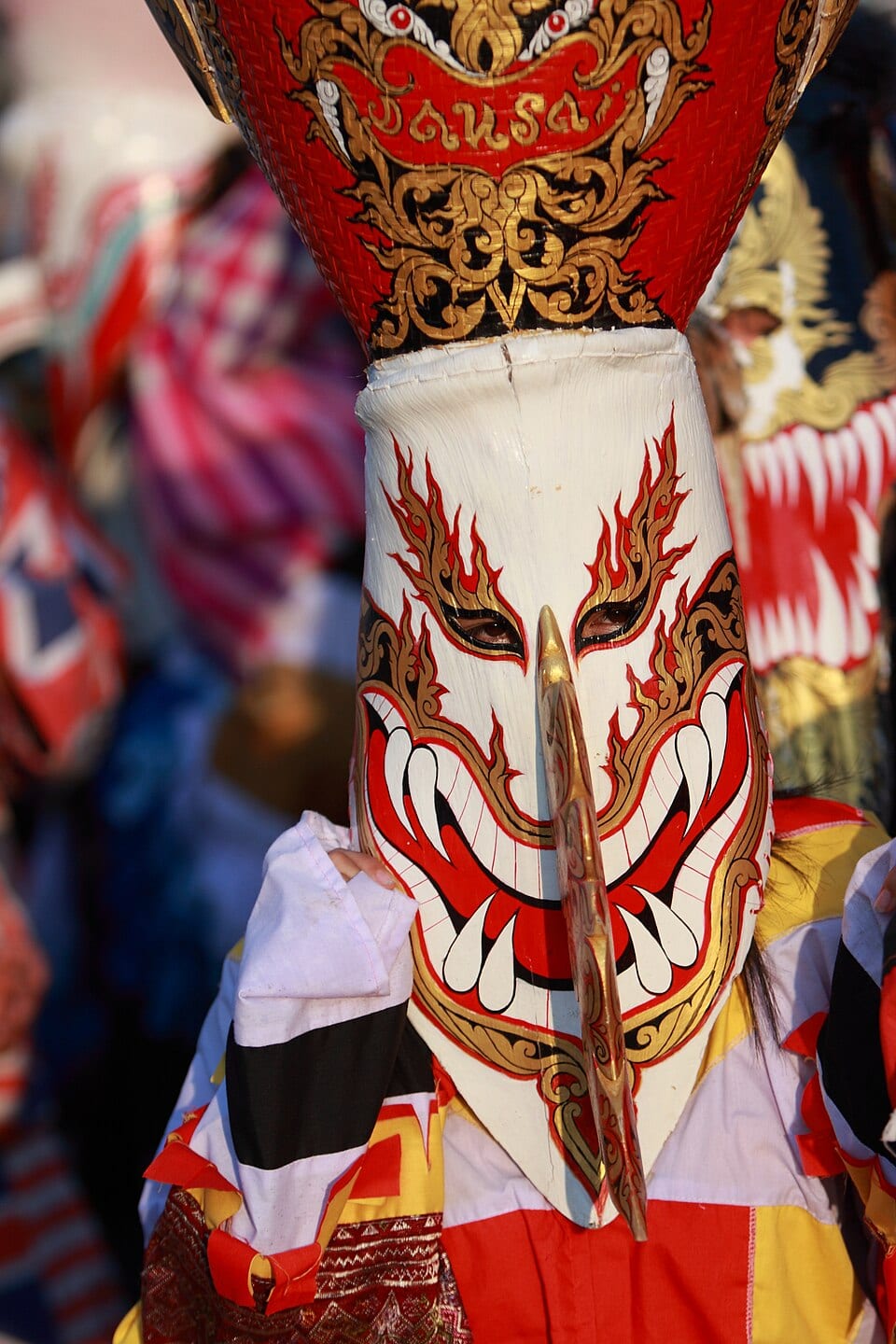
The story holds that when Prince Vessantara returned to his city, the celebration was so loud it woke the spirits of the dead, who came along to join in. The masked figures are those spirits. The masks are made from a rice steamer for the crown and a carved palm base for the face, with a long hooked nose and vivid patterns, and each one is made by the person who wears it.
What happens
Day one belongs to the spirits. Masked villagers roam Dan Sai teasing onlookers, dancing to drums, drinking, and generally misbehaving in a way that is sanctioned precisely once a year.
Day two brings the main procession to Wat Phon Chai, with the masks at their best in daylight, music, and a rocket-firing element that connects the festival to Bun Bang Fai.
Day three turns serious. The masks come off, the spirits are formally dismissed, and the village gathers in the temple to hear the thirteen sermons of the Phra Wet recited. The shift in tone is abrupt and is the part that most explains what the festival actually is.
When it happens
There is no rule to work from. The dates are revealed each year by the town's spirit medium.
| Year | Dates | Notes |
|---|---|---|
| 2027 | June or early July | Announced only a few months ahead by the village spirit medium |
| 2028 | June or early July | — |
The date problem
The dates are not fixed and not set by a calendar. They are determined each year by the town's spirit medium through consultation with the guardian spirits, and announced only a few months in advance. You cannot reliably book flights a year out for this one.
Dan Sai is a small town with very limited accommodation that fills completely. Many visitors stay in Loei town or at Chiang Khan and travel in for the day, which is the safer plan.
The festival is deliberately bawdy — the masked spirits carry wooden phalluses and tease the crowd, especially unaccompanied women and visitors. It is good-natured and nobody is singled out cruelly, but it is worth knowing before you arrive.
Getting there
From Bangkok: Fly to Loei (LOE), then about 80 km by road to Dan Sai. Flights are limited, so book early for festival dates. 1 hr flight + 1.5 hrs road.
From Bangkok: Overnight buses run to Loei town, with onward minivans and songthaews to Dan Sai. 10–11 hrs.
From Chiang Mai: Loei connects east along the northern route via Phitsanulok. Long but scenic, and it pairs the festival with Chiang Khan on the Mekong. 8–9 hrs.
Loei is one of Thailand's least-visited provinces and worth more than the festival alone. Chiang Khan, a restored wooden shophouse town on the Mekong, is about ninety minutes away and makes a far more comfortable base than Dan Sai.
Making the masks
Each mask is made by the person who will wear it, and the construction is specific. The crown is a huad, the woven bamboo steamer used for sticky rice, turned upside down. The face is carved from the trunk of a coconut palm. The nose is long and hooked, and the whole thing is painted in whatever the maker chooses — which is why no two are alike and why the designs have grown steadily wilder.
The costume is sewn from strips of old cloth, and bells are strapped to the back so that every movement is audible. Some wearers carry a carved wooden phallus, which is a fertility symbol and also licence to misbehave.
Masks are sold in Dan Sai year-round and the better ones are genuine folk art rather than souvenirs.
Where to base yourself
Dan Sai has very little accommodation and what exists is booked long before the dates are even announced.
Loei town, about 80 km away, has proper hotels and is the practical choice. Chiang Khan on the Mekong is ninety minutes out, a restored wooden shophouse town that is one of the nicest places to stay in the northeast, and a far better base than either.
Both mean an early start on procession day, which is worth it for having somewhere decent to sleep.
What it costs
Free to attend. Loei is one of the cheapest provinces in Thailand for food and accommodation, and the only real expense is reaching it — flights to Loei are limited and rise sharply once the festival dates are announced.
Booking the moment the medium's announcement circulates is the difference between a reasonable trip and an expensive one.
Why go
Because there is nothing else like it, and because it is still a village festival rather than a tourist product — the masks are made by the people wearing them, the sermons on the third day are the point, and the whole thing would happen exactly the same way if no outsider ever turned up.
The catch is the booking problem. If you want to see Phi Ta Khon, you need to be flexible enough to arrange a trip on a few months' notice.