Chinese New Year in Bangkok
- 🎭 Lion dances
- 🍜 Street food
- 📸 Red lanterns
- 🚇 Easy city access
Thailand has one of the largest Chinese-descended populations outside China, and at Chinese New Year it shows. Bangkok closes Yaowarat Road to traffic, hangs it with red lanterns end to end, and fills it with lion dances, drums, street food and several hundred thousand people. Phuket Town and Hat Yai run their own versions, and in all three the food is the main event.
What happens
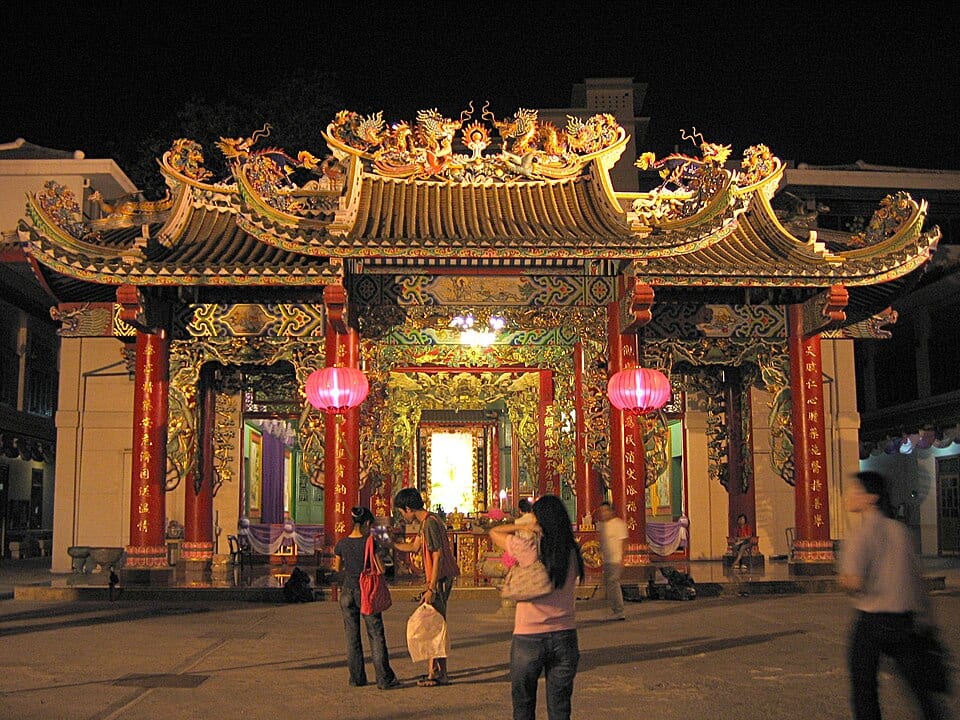
In Bangkok the centre of it is Yaowarat Road, pedestrianised and strung with lanterns for the occasion. Lion and dragon dance troupes work their way along the street and between the shophouses, stopping to perform outside businesses for luck. The Chinese shrines — Wat Mangkon Kamalawat above all — run ceremonies through the day with enormous quantities of incense.
Thai royals have historically attended the Yaowarat celebrations, which is part of why Bangkok's version is the grandest in the country.
Around all of that, Chinatown does what it does best: food, in volume, until very late. Many stalls put on dishes specific to the new year, and this is one of the few nights when the whole district operates at once.
When it happens
Chinese New Year follows the Chinese lunar calendar, which puts it between late January and mid February.
| Year | Dates | Notes |
|---|---|---|
| 2026 | 17 February | Celebrations run across the surrounding days |
| 2027 | 6–7 February | — |
| 2028 | Late January | Lunar date, confirmed closer to the time |
Celebrations typically run over three days — the day before, the day itself and the day after — with the biggest crowds on the eve and the first day.
Worth knowing
Yaowarat is closed to vehicles and extremely crowded on the main evening. Take the MRT to Wat Mangkon and walk; do not attempt a taxi or a Grab anywhere near Chinatown.
Many Chinese-Thai businesses close for a day or two around the new year, including some of the restaurants people make the trip for. If there is a specific place you want to eat, check before you go.
The main celebration is one evening, but the surrounding week carries decorations, shrine ceremonies and markets. If crowds are not your thing, go a day or two either side for the atmosphere without the crush.
Bangkok, Phuket or Hat Yai
Bangkok (Yaowarat) is the biggest and the most spectacular, and the easiest to reach. It is also by far the most crowded.
Phuket Town runs its celebration through the Sino-Portuguese old town, which is a more attractive setting than anywhere in Bangkok and considerably calmer. Phuket's Chinese heritage is deep — the same community behind the Vegetarian Festival — and the old town does the decorations beautifully.
Hat Yai, in the deep south, has a large Chinese-Thai population and draws Malaysian and Singaporean visitors across the border for the holiday. It is the least touristed of the three and the most locally focused.
Getting there
From anywhere in Bangkok: MRT Blue Line to Wat Mangkon, which exits into the middle of Chinatown. Yaowarat Road itself is closed to traffic, so a taxi will leave you a long walk away in heavy congestion. 15–25 min from the centre.
From Suvarnabhumi (BKK): Airport Rail Link to Phetchaburi, then the MRT Blue Line to Wat Mangkon. About an hour.
What to eat
The food is the reason to come, and the new year brings dishes you will not find on Yaowarat the rest of the year.
Look for oranges and pomelo stacked everywhere, given as gifts and offerings for prosperity. Nian gao, the sticky sweet new year cake, appears in the Chinese bakeries. Whole steamed fish, roast duck and long uncut noodles all carry meaning — the fish for abundance, the noodles for long life.
Beyond the festival dishes, Yaowarat's standing greatest hits are all operating: the bird's nest and shark fin shops, the grilled seafood stalls that take over the pavement after dark, the Hokkien noodle houses, and the dessert carts near Wat Traimit.
Getting the most out of the evening
Arrive before dark and walk the street while you still can. By mid-evening the crowd is shoulder to shoulder and you will move at whatever pace it moves.
Wat Traimit at the Hua Lamphong end holds the five-tonne solid gold Buddha and is worth seeing before the crowds. Wat Mangkon Kamalawat is the ceremonial heart of the evening and will be thick with incense smoke.
Soi Nana and Talat Noi, just off Yaowarat, give you somewhere to eat and drink when the main road becomes impassable — and both are interesting in their own right.
What it costs
Free to attend. Food is street-stall priced, though some restaurants run set new year menus at a premium. Hotel rates in Bangkok rise modestly because this falls in high season anyway, rather than because of the festival.
Why go
Because it is the one night of the year when Bangkok's Chinatown is fully given over to itself, with the traffic gone and the whole street usable on foot. If you have only ever experienced Yaowarat as a six-lane road you dart across between food stalls, seeing it closed and lantern-lit is a genuine transformation.
It also sits in high season with reliably good weather, which makes it one of the more comfortable festivals on the Thai calendar to attend.